
How should managed IT support for VoIP monitor call quality?
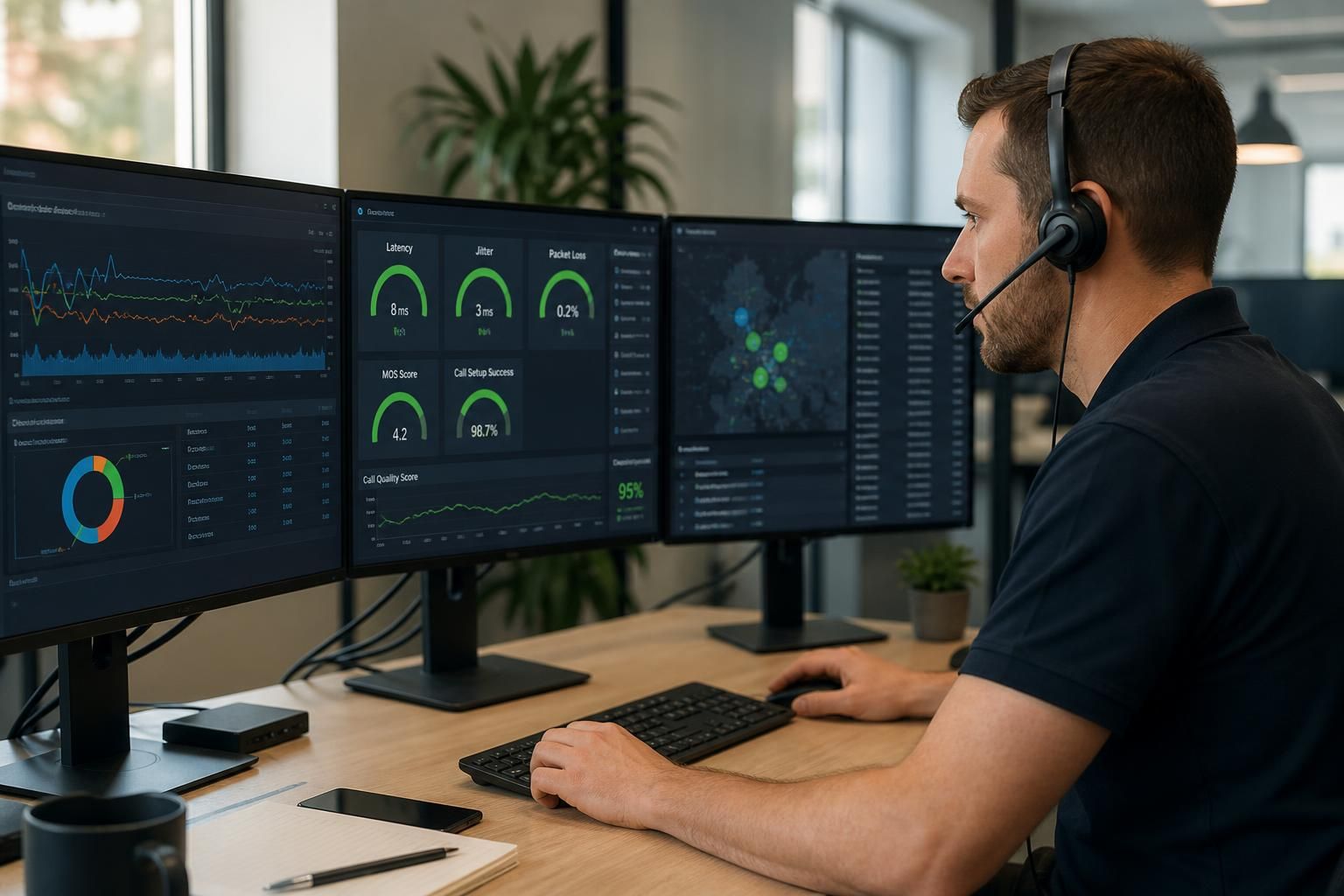
Managed IT support for VoIP should monitor call quality by tracking latency, jitter, packet loss and other network indicators alongside user reports and call-quality scores. Reviewing these measures over time helps identify whether problems originate in the internet connection, local network, handsets, softphones or VoIP configuration, allowing the underlying cause to be investigated.
Managed IT support for VoIP should monitor call quality as an ongoing service rather than relying only on complaints. A useful approach combines network telemetry, VoIP platform data, endpoint information and structured feedback from users. This shows how often poor-quality calls occur, which locations or call paths are affected, and whether a problem is isolated or part of a wider trend.
Establishing a meaningful baseline
Call quality needs to be assessed against normal operating conditions for the organisation. Monitoring should record typical performance by site, connection type, department and calling method, such as desk phones or softphones. A baseline makes it easier to distinguish an unusual incident from expected variation and helps identify gradual deterioration before it becomes a widespread user issue.
The baseline should account for different call paths. A call between two users in the same office may behave differently from a call involving a remote worker, another branch or an external telephone network. Comparing these paths can indicate whether the fault is associated with a particular office, connection, route or service component.
Using objective and user-focused measures
Monitoring tools can produce a call-quality score derived from several technical conditions. Such scores are useful for spotting patterns, but they should not be treated as a complete explanation. A call may receive an acceptable overall score while a short interruption, distorted speech or one-way audio still affects the conversation.
For that reason, technical monitoring should be combined with user reports. Support teams can record the time of the call, the users or locations involved, the type of symptom and whether the issue affected one call or several. Descriptions such as clipped speech, echo, silence or delayed conversation can help connect a user experience to the relevant technical data.
Monitoring continuously and investigating incidents
Effective monitoring looks for both live issues and recurring patterns. An alert may be appropriate when performance moves outside an agreed operational range, when several calls are affected in the same location, or when a particular route repeatedly produces poor results. Alerts should be designed carefully: excessive notifications can obscure important events, while thresholds that are too broad may allow users to experience problems before anyone investigates.
When an issue is detected, the investigation should follow the call path in stages:
- Confirm the time, users, location and symptoms of the affected call.
- Compare the event with other calls made during the same period.
- Check whether the issue is limited to one endpoint, site, connection or route.
- Review relevant VoIP platform events and network records.
- Test the suspected part of the service without changing unrelated settings.
- Apply a controlled correction and verify the result with further calls.
This process helps avoid treating every poor-quality call as an internet problem. The cause may instead be local congestion, unsuitable traffic handling, a misconfigured network device, an endpoint fault, a platform setting or an issue affecting the external call route. Evidence from several sources is more reliable than a single diagnostic screen.
Tracking quality by location and service component
For organisations with multiple offices or remote users, reports should separate results by site and connection. This can reveal that call quality is consistently weaker in one location or during a particular operating pattern. It also supports informed decisions about network changes, traffic prioritisation, connection capacity and the placement of VoIP services.
Monitoring should also distinguish between voice quality and other service statistics. A high number of calls does not necessarily indicate good voice performance, and a low number of reported faults does not prove that every call is clear. The most useful reports combine trends, affected users, technical evidence and the actions taken.
Turning monitoring into preventative support
Historical data allows managed IT support to identify recurring conditions rather than repeatedly treating individual symptoms. For example, if quality declines whenever other business traffic increases, the underlying traffic-handling design may need review. If problems follow a particular office, device group or call route, investigation can focus on that area instead of applying broad changes across the whole environment.
After any corrective action, monitoring should continue long enough to establish whether the issue has genuinely stopped. The support record should document the symptoms, evidence considered, changes made and verification results. This creates a useful technical history for future incidents and supports planned improvements to the organisation’s VoIP environment.
For businesses in and around Stourbridge, Kinver, Wordsley, Kingswinford, Kidderminster, Halesowen, Dudley and neighbouring areas, a managed IT support provider can apply this monitoring process across office and remote-working arrangements. The important measure is not simply whether a dashboard reports a normal status, but whether the available evidence explains the quality users experience and supports a verified, lasting response.
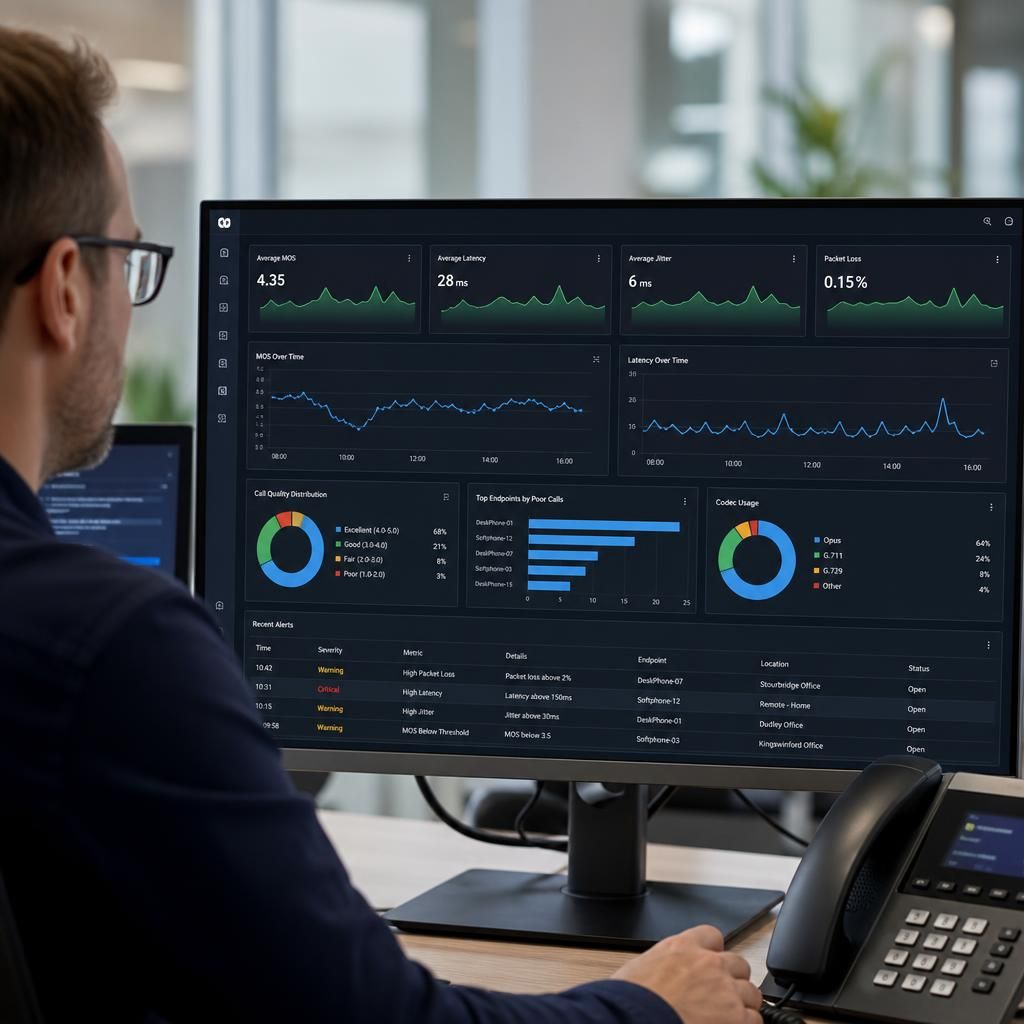
Call-quality monitoring does not usually require the support team to listen to conversations. Technical data such as latency, jitter, packet loss, codec information, timestamps and endpoint details can show how a call performed without capturing its content. This separates service diagnostics from call recording and reduces the amount of sensitive business information involved in routine investigations.
Access to monitoring data should still be controlled. Reports should be limited to authorised personnel, retained only for a defined operational purpose and associated with clear records of any investigation. Where a quality issue is escalated, the support record can describe the affected call, technical findings and corrective action without storing unnecessary conversation content. This approach provides useful evidence while supporting responsible handling of business communications.