

How should managed IT support assess compliance for VoIP call recording?
Managed IT support should assess VoIP call recording compliance by documenting the purpose and lawful basis for recording, informing callers, controlling access and setting appropriate retention and deletion rules. The assessment should also consider UK GDPR, the Data Protection Act 2018, PECR and any sector-specific requirements, with secure storage and regular reviews of the recording configuration.
Assessing VoIP call recording compliance means carrying out a documented gap analysis of how recordings are created, used, accessed, transferred and removed, then matching each stage to the organisation’s legal obligations and internal policies. A sound assessment examines the complete recording service rather than treating compliance as a single setting in the phone system.
Start by mapping the recording lifecycle. Document which numbers, users, departments and call types are recorded. This should include inbound and outbound calls, internal calls, transferred calls, conference calls, voicemail, mobile extensions, softphones and calls routed through queues or failover systems. The assessment should also identify whether the platform creates related data such as caller numbers, timestamps, user names, recordings, transcriptions, summaries, screen captures or call analytics.
This inventory often reveals separate recording paths that are not governed by the main telephony platform. For example, a user might download an audio file, send it by email, save it in a customer relationship system or create a transcript through another application. Each copy and connected service forms part of the compliance scope.
Confirm accountability and supplier responsibilities. The organisation usually remains responsible for deciding why calls are recorded and how the information is used, even where a managed IT provider or VoIP supplier operates the technology. The assessment should therefore distinguish between the organisation’s role as data controller and any provider acting as a data processor.
Supplier documentation should be checked for:
- the processing instructions and purposes covered by the contract;
- hosting locations and any international transfers;
- sub-processors involved in recording, transcription, storage or support;
- security obligations, incident notification arrangements and audit rights;
- data return and deletion arrangements when a service or user account ends; and
- the provider’s ability to support data subject requests and investigations.
A managed IT support team can help gather this information, compare the configured service with the contract and identify gaps. It should not assume that a supplier’s general statement that a platform is secure proves that the organisation’s particular use of it is compliant.
Test whether recording is necessary and proportionate. The assessment should compare the stated business purpose with the scope of recording. Recording every conversation may create a larger volume of personal data than is needed for a particular objective. Alternatives may include recording selected teams, specific call types, a defined part of a call or only calls where a documented business need exists.
Necessity should be considered separately for audio, transcription, automated summaries and screen recording. A transcription or artificial intelligence feature can create additional searchable copies and may expose information to another service, even when the original audio remains in the phone system. Features that are not required for the stated purpose should be disabled or excluded from the assessment scope.
Consider the information contained in calls. Recordings may include names, contact details, account information, employment details, financial information or commercially confidential material. A call may also capture special category data, payment card information or information about another person who was not expected to be recorded. The assessment should identify these possibilities and document the controls used to reduce exposure.
For payment discussions, check whether the telephony service supports pause, mute, masking or dual-tone multi-frequency suppression. Test those controls rather than relying on a product description. The assessment should establish what happens if a call is transferred, placed on hold, recorded through a different device or continued after the suppression feature is activated.
Review data subject rights and operational procedures. The organisation should be able to locate relevant recordings when responding to a subject access request or another valid request. This requires searchable identifiers, consistent user and customer records, and a process for handling recordings that contain information about other people.
Recordings can be difficult to amend because editing the original audio may undermine its evidential value. The assessment should define how inaccurate information, objections, restrictions or deletion requests are handled, including whether access is limited while a dispute or investigation is considered. It should also address legal holds, complaints, litigation and regulatory investigations so that routine deletion does not remove information that must properly be preserved.
Assess access and export behaviour in practice. The review should test permissions for administrators, supervisors, agents, external support personnel and connected applications. It should verify that access is based on job requirements, that departed users lose access, and that privileged activity is recorded in an audit trail. Download, playback, sharing and bulk-export permissions deserve separate attention because a user who cannot change system settings may still be able to copy large numbers of recordings.
Test recordings should be used to confirm that:
- users can access only the calls appropriate to their role;
- administrators cannot silently bypass the organisation’s controls;
- exports do not expose recordings through publicly accessible links;
- connected business applications receive only the fields and recordings they require; and
- audit records show who accessed, exported or changed a recording.
Check notices, policies and user understanding. Compliance depends on consistent practice as well as technical configuration. Staff who record or retrieve calls should know the approved purposes, restrictions on copying, procedures for sensitive information and the escalation route for mistakes. Internal policies should match the actual VoIP configuration, including any changes introduced by new users, call flows or integrations.
Customer-facing information should also be checked across greetings, websites, contracts and other relevant communications. It should not describe controls that the system does not apply, such as claiming that recordings are automatically deleted when no tested deletion process exists.
Complete a risk assessment and retain evidence. A Data Protection Impact Assessment may be appropriate where recording involves systematic monitoring, large-scale processing, vulnerable individuals, sensitive information or extensive analysis. The assessment should explain the processing, the risks to individuals, the safeguards selected and any remaining risks requiring management approval.
The compliance file should normally include the recording inventory, purpose assessment, data-flow diagram, supplier terms, configuration record, access review, test results, staff guidance, incident process and review history. Periodic reassessment is particularly important after changes to call flows, recording providers, transcription features, storage locations or connected business systems. This evidence allows the organisation to demonstrate that compliance was assessed against its actual VoIP environment rather than assumed from a product’s standard configuration.
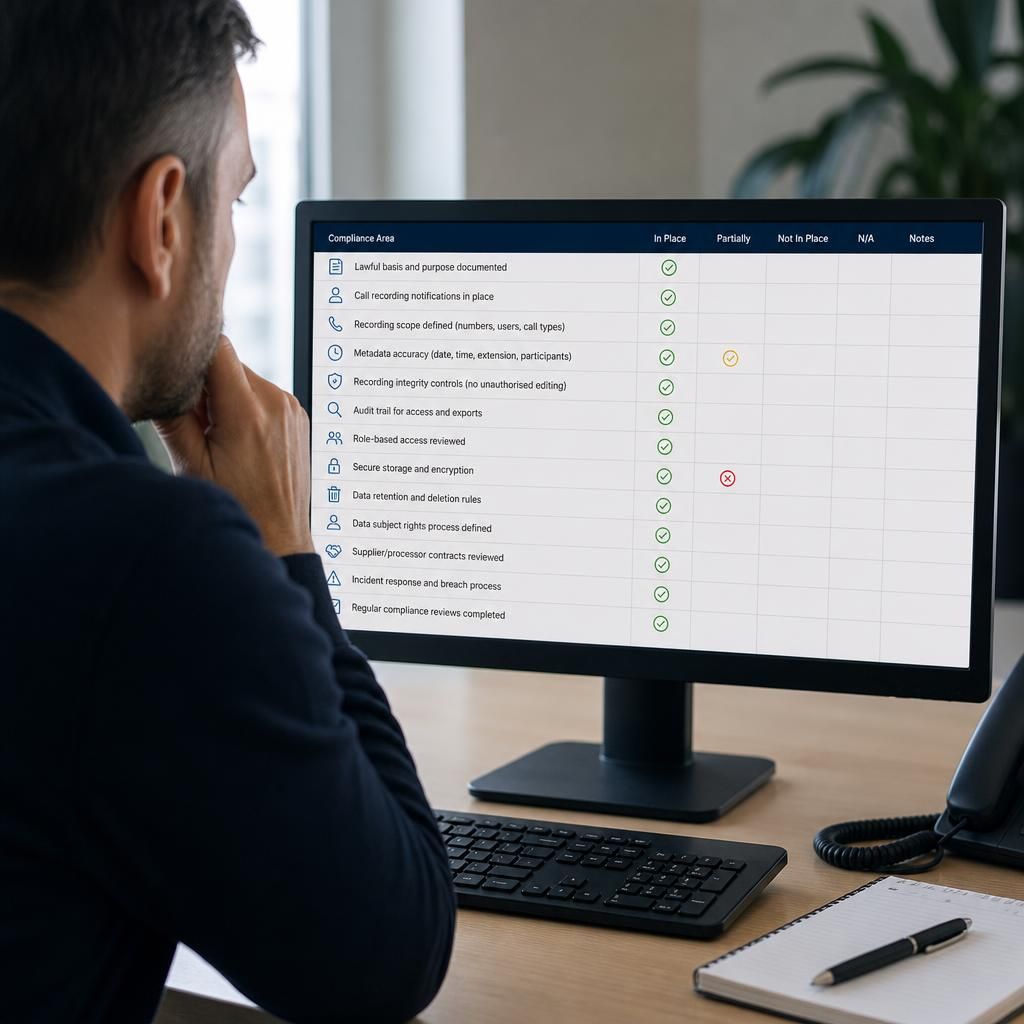
A compliance assessment should test whether VoIP recordings remain accurate and trustworthy when they are used to investigate complaints, confirm instructions or support a contractual dispute. This involves checking that each file retains reliable information about the date, time, extension, participants and call direction, rather than assessing only whether the audio can be played.
Review how the system protects the original recording after creation. Controls may include restricted editing, documented export procedures, audit records for access and a clear distinction between the original audio and any enhanced, clipped or transcribed copy. Clock settings should also be consistent across the telephony platform and related systems, because conflicting timestamps can make an otherwise useful record difficult to interpret.
The assessment should document who may approve an export, where it is stored, how its integrity is verified and how the recipient is identified. These measures help ensure that a recording used in an investigation is traceable from the source system to the person reviewing it, without treating an altered copy as the original evidence.