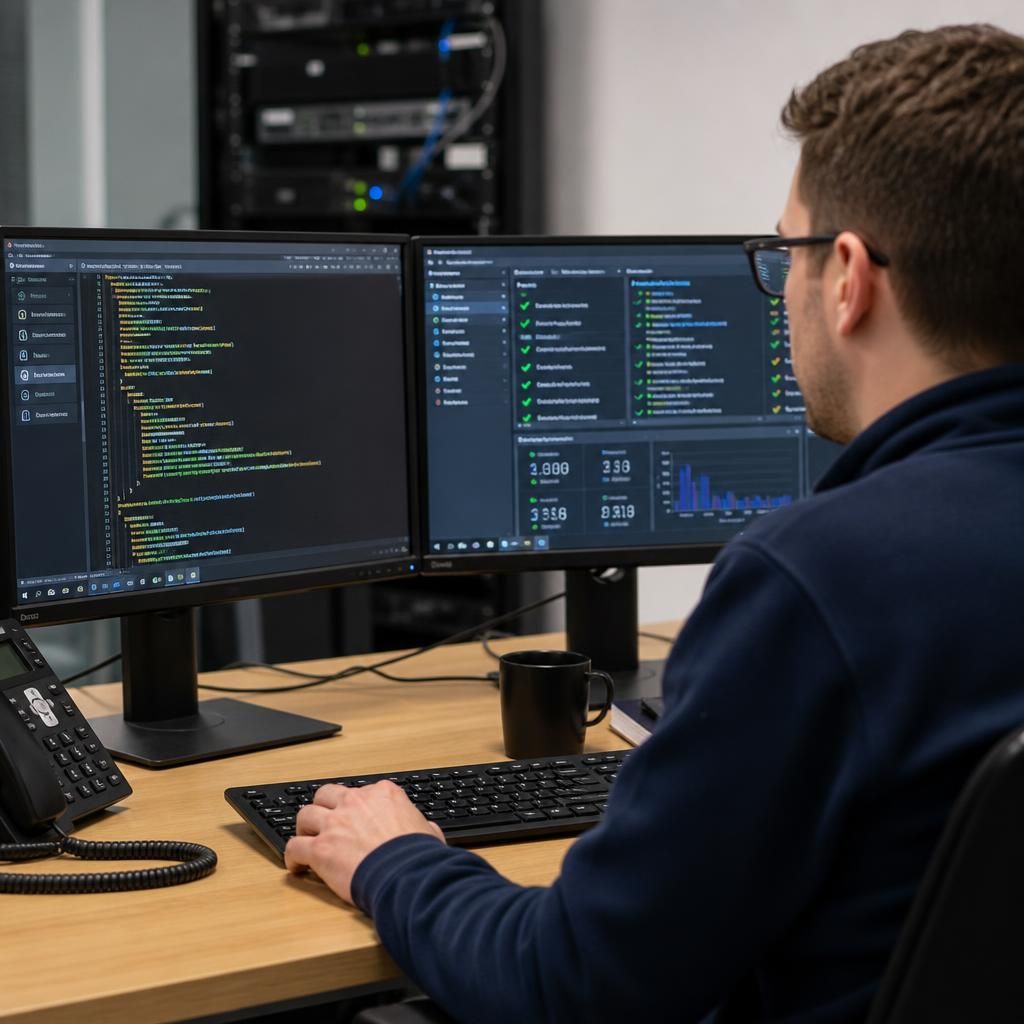
How are infrastructure changes tested before they affect production systems?
Infrastructure changes are tested in a controlled, non-production environment first, where configuration, compatibility, security and performance can be assessed without affecting live services. Once the results are reviewed, the change is scheduled for production with documented approval, monitoring and a tested rollback plan.
Infrastructure changes are tested through a documented sequence of technical checks, business validation and evidence review before they are permitted to affect live services. The aim is not simply to confirm that a new configuration works in isolation, but to establish that it remains compatible with connected systems, security controls, user requirements and operational processes.
The process normally begins by defining the change clearly. This includes the intended outcome, the systems involved, dependencies, expected user impact and measurable acceptance criteria. A network rule change, for example, may need to be assessed against authentication services, applications, remote access, monitoring and data flows rather than being treated as an isolated firewall adjustment. Establishing these relationships helps identify tests that reflect how the environment is actually used.
The test environment should be sufficiently representative of the live infrastructure to produce meaningful results. Relevant operating system versions, application dependencies, identity settings, permissions, network paths and integrations are considered when preparing the test. Where real business data is needed, it should be minimised, anonymised or replaced with suitable test data so that testing does not create an unnecessary data protection risk.
Testing is usually divided into several checks:
- Functional testing: confirms that the changed service or configuration performs its intended task.
- Compatibility testing: checks interactions with dependent applications, devices, operating systems, cloud services and older components.
- Security testing: verifies that access controls, authentication, permissions, encryption and monitoring continue to operate as required.
- Performance testing: examines resource use, capacity, latency and stability under representative conditions.
- Operational testing: confirms that alerting, backups, logging, support procedures and administration tools still work after the change.
Changes should be tested against both normal and adverse conditions. This can include invalid credentials, unavailable dependencies, interrupted connections, unexpected input, service restarts and partial failures. These scenarios show whether the change fails in a controlled way and whether administrators receive enough information to identify and correct a problem.
Automated checks are useful for repeatable tasks such as configuration comparison, policy validation, deployment checks and service health tests. They should be supplemented by manual review where judgement is needed, particularly for changes involving access rights, business-critical workflows or complex integrations. A second technical review can identify assumptions or omissions that the person preparing the change may not notice.
Business representatives may also need to validate the change. Technical success does not necessarily mean that a process remains usable for staff. Appropriate users can check key workflows, permissions, reports and integrations against agreed acceptance criteria. Any failed test, unexplained variation or unresolved warning should be recorded rather than being treated as an informal exception.
Test results should provide an auditable record of what was assessed, which configuration was used, who performed the checks, what evidence was produced and whether the acceptance criteria were met. This documentation supports an informed decision about whether the change is suitable for implementation, requires further testing or should be redesigned. It also creates a useful reference when investigating later issues or repeating the change in another environment.
For recurring infrastructure work, the testing process can be improved by using standard test plans, configuration baselines, scripted validation and lessons from previous changes. Each change should still be assessed on its own characteristics: a routine software update, a major identity alteration and a network redesign carry different dependencies and require different evidence. S2 Technology Group can help businesses structure this testing as part of managed IT infrastructure, aligning technical verification with operational and security requirements.
Infrastructure testing should assess the implementation procedure as well as the final configuration. A change can produce the correct end state in a test environment but still create risk if deployment steps are performed in the wrong order, a prerequisite is missed or a service is restarted unexpectedly.
A controlled rehearsal follows the proposed runbook from start to finish. It confirms the required permissions, dependencies, command sequence, checkpoints and communication steps. The plan should also define clear abort conditions, such as an unexpected service interruption or failed validation check, so the person carrying out the work knows when to stop rather than continue into an uncertain state.
Rehearsal results can then be used to refine the production procedure. The final runbook should identify each action, its expected result, the person responsible for confirming it and the evidence to retain. This makes implementation more consistent and gives the technical team a practical basis for deciding whether the change is ready to proceed.