

How are project risks identified before IT implementation begins?
IT project risks are identified before implementation through a structured assessment of the proposed changes, existing systems, security controls, dependencies and business requirements. Each risk is evaluated for its likelihood and potential impact, then assigned an appropriate mitigation, owner and review point before delivery begins.
Before an IT implementation begins, risks are identified by comparing the proposed change with the organisation’s current technology, operating requirements and tolerance for disruption. The process combines technical discovery, business consultation and review of the implementation plan so that uncertainties are recorded before they affect delivery.
1. Define the change and its boundaries
The first step is to establish exactly what the project will alter, replace, connect or introduce. This includes the systems involved, the locations and users affected, the intended outcomes, and any work that is explicitly outside the project. Unclear boundaries create risk because important tasks can be missed or assumed to belong to someone else.
The assessment should also identify constraints such as fixed deadlines, contractual commitments, regulatory requirements, budget limits and restrictions on when changes can be made. These constraints may reduce the available options or increase the consequences of delay.
2. Examine the existing environment
A review of the current environment shows how the proposed implementation fits into the organisation’s technology. Depending on the project, this may cover:
- servers, workstations, mobile devices and network equipment;
- operating systems, applications and licensing arrangements;
- user accounts, permissions and authentication methods;
- internet connections, remote access and site-to-site links;
- data locations, backup arrangements and recovery procedures;
- legacy systems, unsupported components and bespoke integrations; and
- configuration standards, monitoring and existing support processes.
Technical records are useful, but they should be checked against the environment itself. Documentation can be incomplete or out of date, while an apparently minor dependency may only become visible when system owners and users explain how services are actually used.
3. Consult the people affected
Risk identification is not solely an infrastructure exercise. Discussions with business managers, system owners and representative users can reveal operational dependencies that are not visible in technical diagrams. For example, a particular report may be needed for daily processing, a shared mailbox may support several teams, or a remote site may depend on a connection that has no practical alternative.
These discussions should establish which activities are critical, what disruption is acceptable, which data must remain available, and how users will be supported during the transition. They also help identify adoption risks, such as insufficient training, unclear responsibilities or a process that the proposed system does not accommodate.
4. Classify the main types of risk
A structured assessment normally considers several categories rather than focusing only on whether the technology will function:
- Technical risk: incompatibility, capacity limitations, configuration errors, unsupported software or failed integrations.
- Security risk: excessive privileges, exposed services, weak authentication, insecure data transfer or controls that are not carried into the new environment.
- Operational risk: interruption to essential work, inadequate support arrangements, unclear procedures or loss of access to required information.
- Data risk: incomplete migration, corruption, duplication, incorrect mapping, loss of metadata or inadequate validation.
- Dependency risk: reliance on a supplier, network connection, application, internal team or prerequisite task that is not ready when needed.
- People and change risk: limited internal capacity, lack of technical knowledge, resistance to a new process or insufficient communication.
- Commercial and compliance risk: licensing obligations, contractual conditions, data-handling requirements or costs created by an overlooked project assumption.
Using categories makes the review more consistent and reduces the chance that a visible technical issue will obscure less obvious business or security concerns.
5. Map dependencies and assumptions
Many implementation problems arise because the project depends on something that has not been verified. A dependency map can show relationships between applications, identity services, network paths, suppliers, data sources and business processes. It should also identify sequencing requirements: for instance, a new access method may depend on directory changes, updated devices or user enrolment being completed first.
Assumptions should be written down and tested. An assumption that all devices meet a software requirement, that a supplier will provide information by a particular point, or that a backup can be restored is a potential risk until evidence confirms it. Making these assumptions visible allows them to be checked before they influence the delivery schedule.
6. Consider failure scenarios and continuity
The project team should assess what could happen if an implementation step does not work as intended. This includes failed installation, incomplete migration, loss of connectivity, authentication failure, incompatible applications and unexpected performance problems. The review should consider both the immediate effect and the consequences if the issue continues.
For significant changes, planning should include a tested rollback or recovery approach where one is technically feasible. This may involve preserving the previous configuration, taking suitable backups, defining restoration steps and deciding who can authorise a return to the earlier state. A backup that has never been checked through a restoration process should not be treated as proof that recovery will work.
7. Assess security before the design is fixed
Security risks are easier to address during design than after deployment. The review should examine how identities will be created and removed, which users and services require access, where data will reside, how administrative activity will be controlled, and what monitoring will be available. Remote access, integrations and temporary project accounts deserve particular attention because they can introduce access paths that remain after the original work is complete.
The assessment should also confirm that security controls do not depend on undocumented manual actions. If a process relies on someone remembering to remove an account, apply a setting or review an alert, that dependency should be made explicit and considered in the operating model.
8. Record findings in a usable risk register
A risk register turns the assessment into a working project document. Each entry should describe the cause, the possible consequence, the affected service or process, the evidence supporting the concern and the action needed to address it. It should also show who is responsible for the action, the point at which it must be completed, and the condition that would indicate the risk has been reduced.
Risks, issues and assumptions should not be confused. A risk is a possible future problem; an issue has already occurred; and an assumption is something accepted for planning purposes that still needs validation. Keeping these records distinct gives the project team a clearer view of what requires prevention, what requires resolution and what requires confirmation.
9. Review the assessment before approval
Risk identification should be reviewed at the design and approval stage, not treated as a one-off checklist. The relevant technical and business stakeholders should confirm that the findings are complete, that proposed controls are practical, and that any remaining exposure is understood by the person authorising the project. If a major uncertainty cannot be resolved before implementation, the project plan may need a further investigation, a controlled pilot or a change to its scope.
For organisations without a full in-house IT team, an IT project management consultant can provide the structure for this discovery and review process, while internal stakeholders contribute knowledge of business priorities and day-to-day dependencies. The result is a more realistic implementation plan based on known conditions rather than untested assumptions.
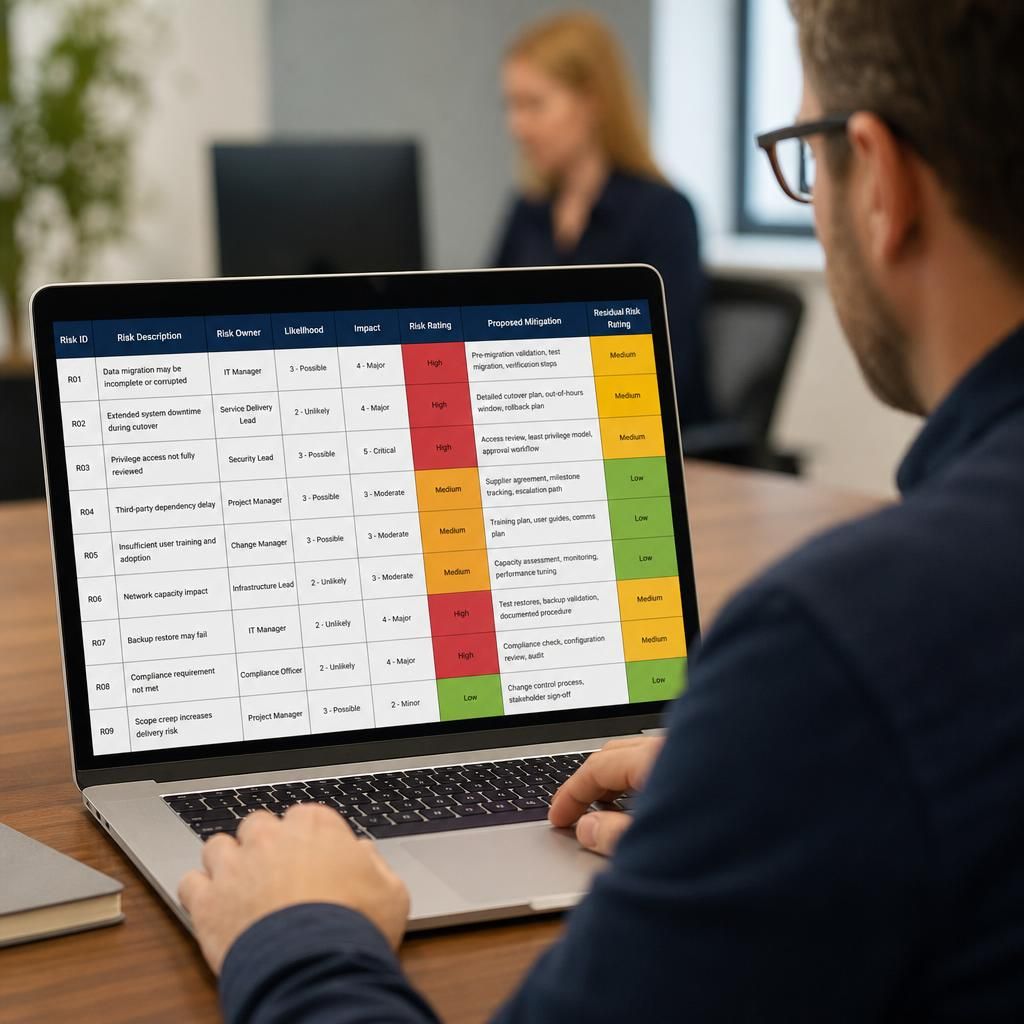
Project risks are prioritised before IT implementation by comparing their potential effect with the organisation’s agreed tolerance for disruption, data loss, security exposure and cost. This helps distinguish risks that require a design change from those that can be monitored or formally accepted.
The assessment should consider both the initial exposure and the residual risk expected after controls are applied. For example, a planned access restriction may reduce security exposure, but the remaining risk could still be unacceptable if privileged accounts are not independently reviewed. Likewise, a short service interruption may be tolerable for one system but unacceptable for a process that supports essential operations.
- High-priority risks may require additional testing, a revised implementation method or approval from a senior decision-maker before work proceeds.
- Moderate risks may be managed through documented controls, monitoring and a defined contingency.
- Low risks can usually be recorded and reviewed without delaying the project, provided circumstances do not change.
Using agreed thresholds prevents risk decisions from being based solely on technical preference. It also makes escalation clearer: the person approving the project can see which exposures remain, why they are considered acceptable and what evidence would trigger a further review.