What is the difference between an IT helpdesk and a service desk?
An IT helpdesk primarily provides technical assistance, troubleshooting and fault resolution for users. A service desk has a broader role: it combines user support with structured service management, including incident handling, service requests, changes, access and communication.
An IT helpdesk is generally a technical support function, while a service desk is a wider IT service management function. The helpdesk concentrates on helping users overcome technology problems. The service desk manages the broader relationship between users and the IT services they depend on, combining support with defined processes for requests, incidents, access, changes and service communication.
The terms are sometimes used interchangeably, so the name alone does not establish what a provider actually does. Some organisations call their entire support operation a helpdesk even when it includes service management processes. Others use “service desk” to describe a function that remains largely focused on troubleshooting. The important distinction is the scope of responsibility, the processes in place and the way work is controlled from initial contact through to completion.
What an IT helpdesk usually does
An IT helpdesk is typically the first point of contact for users experiencing a technical difficulty. Its work may include:
- Diagnosing problems with computers, applications, email, printers, networks and user accounts.
- Guiding users through standard fixes and configuration steps.
- Resolving faults remotely where the issue can be addressed without attending the user’s location.
- Recording support requests and tracking their progress.
- Escalating complex or recurring problems to specialist technical teams.
- Providing information about known faults, workarounds and planned technical activity.
The helpdesk is therefore centred on restoring a user’s ability to work or providing practical assistance with a particular technical task. It may use a ticketing system, knowledge base and escalation procedures, but its main measure of activity is the effective handling of user contacts and technical issues.
What a service desk adds
A service desk places individual support contacts within a structured service management framework. In addition to handling faults, it may coordinate routine requests such as new user access, equipment provision, software installation and account changes. It can also manage the communication and approvals associated with technology services.
This broader function commonly includes:
- Incident management: coordinating the restoration of an affected service and maintaining a clear record of the issue.
- Service request fulfilment: processing standard, repeatable requests through an agreed procedure.
- Access management: controlling requests to create, alter or remove access in line with authorisation requirements.
- Change coordination: ensuring that planned alterations are assessed, approved, documented and communicated appropriately.
- Problem management: investigating underlying or recurring causes rather than repeatedly treating the same symptoms.
- Configuration and asset information: maintaining useful records about devices, systems, users and the relationships between them.
- Service communication: explaining disruptions, planned maintenance, request progress and relevant user actions.
Not every service desk performs all these activities directly. It may coordinate with infrastructure, security, software or third-party teams while retaining responsibility for the overall user-facing process.
The difference in perspective
A helpdesk usually asks, “How do we fix this user’s technical problem?” A service desk also asks, “Which service is affected, who is authorised to request action, what process applies, what other users or systems could be affected, and how should the outcome be recorded?” This distinction matters when technology supports several departments, multiple locations or business-critical processes.
For example, if one employee cannot access an application, a helpdesk may troubleshoot the device, confirm the account details and restore access. A service desk would also consider whether the issue is part of a wider incident, whether access should be approved by the employee’s manager, whether similar accounts are affected and whether the underlying cause needs further investigation.
How ticket handling differs
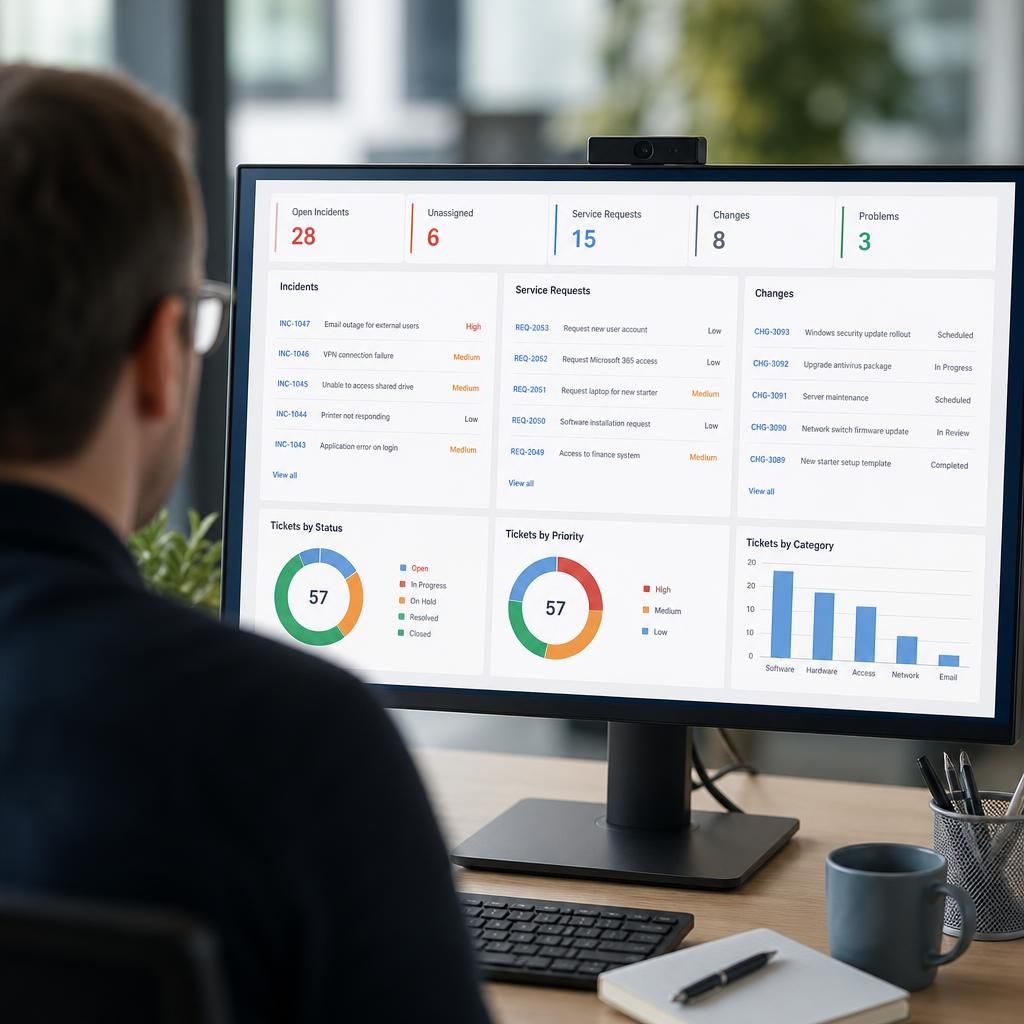
Both functions can use tickets, but a service desk normally applies more consistent classification and governance. A ticket may record the user, affected service, symptoms, business impact, priority, actions taken, approvals, communications, resolution and closure information. This creates an auditable history rather than a brief note that a problem was fixed.
Service desk processes also distinguish between different types of work. An incident is an unplanned interruption or reduction in the quality of a service. A service request is a standard request for something already defined, such as access or equipment. A change is a controlled alteration to a system or environment. Separating these categories helps determine the correct workflow, authority and risk controls.
How escalation works
In a basic helpdesk model, unresolved issues are passed to a second-line or specialist technician. A service desk may still use technical escalation, but it also manages functional escalation. This can involve informing a service owner, seeking an approval, involving a security specialist or coordinating with a supplier.
Escalation should preserve ownership of the request. Passing a ticket to another technical team does not necessarily mean the user is responsible for finding out what happens next. A well-defined service desk process records the handover, keeps relevant teams informed and confirms the eventual resolution or agreed next step.
Which model does a business need?
A small organisation with straightforward systems may need a responsive technical helpdesk with clear ticket records and sensible escalation. As the organisation grows, adds sites, introduces cloud services or handles more sensitive information, the wider controls associated with a service desk become increasingly useful.
Indicators that a broader service desk approach may be appropriate include:
- Users need a consistent way to request access, equipment or software.
- Several teams or locations depend on shared systems.
- Changes to technology could disrupt operations or create security risks.
- The organisation needs evidence of who approved access or authorised a change.
- The same faults recur and require investigation beyond individual fixes.
- Management needs meaningful information about service issues, request volumes, recurring causes and outstanding work.
How to compare providers or internal teams
Ask what the function is responsible for rather than relying on whether it is called a helpdesk or service desk. Useful questions include:
- How are incidents, service requests and changes categorised?
- How are priority and business impact assessed?
- What information is captured in each ticket?
- How are access requests approved and removed when a user leaves?
- How are recurring problems identified and investigated?
- How are users informed about incidents and planned changes?
- Which issues are resolved by the first-line team and which are escalated?
- How are responsibilities divided between the support function, system owners and external suppliers?
In practice, an IT helpdesk can be one component of a service desk. The helpdesk supplies the technical user support element, while the service desk adds the governance, coordination and service management processes needed to operate technology in a controlled and consistent way.
A useful practical distinction is that a service desk normally defines how users access IT services, not just how they report faults. It may maintain a service catalogue describing supported systems, standard requests, required information and the approvals that apply. This gives users and managers a clearer route for requesting help with equipment, accounts or software, while allowing the support team to apply the appropriate process.
An IT helpdesk can resolve many of the same technical issues without maintaining this wider catalogue or formal service structure. The difference is therefore visible in the consistency of the user journey: a helpdesk may record and resolve an individual problem, whereas a service desk connects support activity with agreed service definitions, ownership and administrative controls. This can be particularly useful when different departments rely on different applications or when technology services are managed across more than one location.