
What does endpoint protection cover in business cyber security?
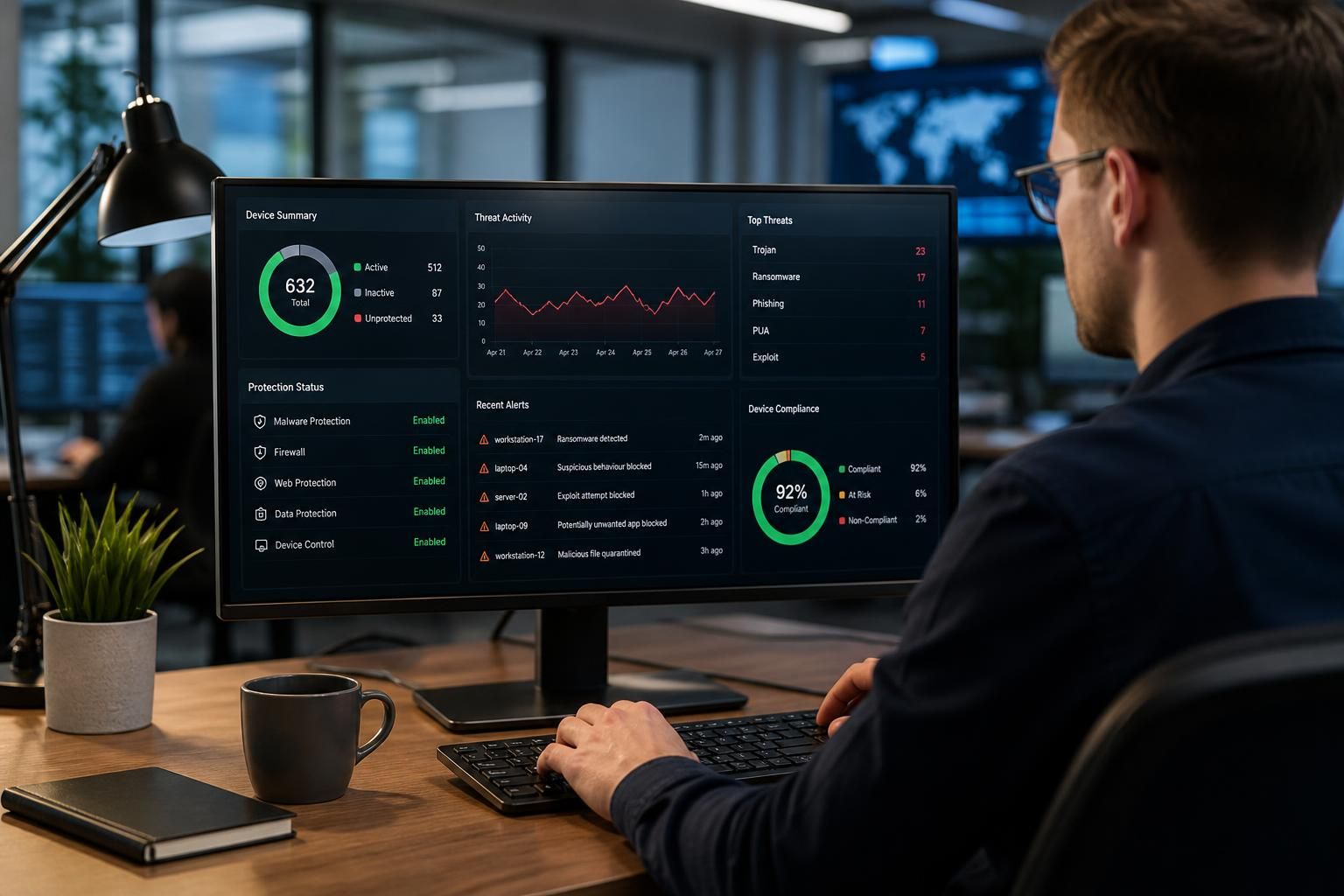
Endpoint protection covers the security of business devices such as laptops, desktops and mobile endpoints, combining malware and ransomware defence with controls that detect, block and contain suspicious activity. It can also include device management, security updates, application and access controls, data protection, and monitoring to reduce the risk of compromised endpoints affecting the wider organisation.
Endpoint protection covers the controls, monitoring and response processes used to secure business devices and prevent them becoming an entry point into the wider organisation. A complete approach goes beyond traditional antivirus: it combines prevention, behavioural detection, investigation, containment and recovery, with policies managed consistently across the endpoint estate.
Prevention before execution
Preventive controls aim to stop a threat before it can run or establish persistence. These may include reputation checking, malicious file analysis, script and macro restrictions, exploit protection, web filtering and controls over removable media. The purpose is not simply to identify known viruses, but to reduce the techniques an attacker can use to deliver code, abuse legitimate tools or persuade a user to open a harmful file.
Application control can add another layer by permitting only approved software or by blocking programmes with a poor security reputation. This is particularly useful where a business needs tighter control over workstations used for financial, operational or sensitive administrative tasks. Policies should be practical, however, because excessive restrictions can encourage users to find unsafe workarounds.
Behavioural detection and endpoint detection and response
Modern endpoint protection monitors activity rather than relying only on static malware signatures. It can identify patterns such as unusual process creation, suspicious PowerShell activity, attempts to disable security tools, unexpected credential access, rapid file changes or communication with known malicious infrastructure. This helps detect new or modified threats that may not yet have a recognised signature.
Endpoint detection and response, commonly called EDR, adds investigation and response capabilities to this telemetry. Security staff can review the sequence of events on a device, identify the initial cause of a suspected compromise and assess whether other endpoints show related activity. Depending on the technology and policy, a device may be isolated from the network while retaining sufficient connectivity for investigation and remediation.
Ransomware and destructive activity controls
Ransomware protection focuses on recognising the behaviours associated with unauthorised encryption, deletion or alteration of files. Controls may include protected folders, suspicious process blocking, tamper protection and alerts for unusual volumes of file activity. These measures should complement, not replace, tested backups, because endpoint controls cannot guarantee that every attack will be prevented.
Where an alert indicates destructive activity, the response process should define who can authorise isolation, how affected accounts and devices are assessed, and how business-critical data is recovered. The quality of the surrounding incident process is therefore an important part of what endpoint protection covers in practice.
Device and security posture assessment
Endpoint protection can assess whether a device meets the organisation’s security requirements. Relevant checks may include whether protective services are running, whether unauthorised changes have been made, whether encryption is enabled, and whether the device is subject to the correct policy. Devices that fall outside the required baseline can be flagged for investigation or restricted from accessing particular resources.
This posture information is useful because a device can be free from an active malware alert while still presenting avoidable risk. For example, disabled protections, unsupported software or excessive local privileges can increase the consequences of a later attack. Endpoint security should therefore be reviewed as an ongoing state rather than treated as a product installed once.
Central policy and administration
A business normally needs central management to apply consistent endpoint policies, review alerts and maintain an audit trail. This can include separate policies for different user groups, device types or risk levels. Administrators should use role-based permissions and strong authentication for the management console, since an attacker who gains control of that console may be able to weaken protection across many devices.
Central administration also supports reporting. Useful reports can show protected devices, unresolved alerts, policy exceptions, isolated endpoints, detection trends and devices that have not recently provided security data. Reports should distinguish between an alert being generated, an alert being investigated and a threat being contained; these are different stages of security activity.
Containment, investigation and remediation
When a threat is detected, endpoint protection may support actions such as isolating the device, terminating a malicious process, quarantining a file, removing persistence mechanisms or collecting forensic information. These actions should follow documented procedures so that evidence is preserved and operational disruption is considered. A device that is isolated too early may affect business processes, while delaying containment can allow an attacker to move to other systems.
Remediation should address the underlying cause rather than simply remove one detected file. The investigation may need to establish how the threat arrived, which user or service account was involved, what data was accessible and whether other endpoints require examination. It may also result in changes to policies, permissions, training or network controls.
How endpoint protection fits with other controls
Endpoint protection is one layer of a wider cyber security architecture. Identity controls help prevent stolen credentials being used, network security can restrict unwanted connections, email security can reduce malicious delivery, and backup and recovery arrangements help restore data after an incident. Cloud services and mobile devices may require additional controls because their management, connectivity and data flows differ from those of traditional office computers.
Endpoint protection also does not remove the need for secure configuration, sensible user permissions, vulnerability management or an incident response plan. Its value depends on the accuracy of its policies, the quality of its monitoring and the organisation’s ability to act on meaningful alerts.
What to assess when reviewing endpoint protection
- Which laptops, desktops, servers and other relevant endpoints are included, and whether any are unmanaged.
- Whether prevention controls cover malware, scripts, exploits, malicious websites and unauthorised applications.
- Whether behavioural telemetry is available for investigation rather than just a simple infected or clean status.
- Whether alerts are prioritised, assigned and reviewed with clear ownership.
- Whether suspicious devices can be contained without relying on an attacker to remain inactive.
- Whether the management system itself is protected through restricted administration and strong authentication.
- Whether exclusions and policy exceptions are documented, justified and reviewed.
- Whether endpoint events are retained for long enough to investigate incidents and identify patterns.
- Whether the organisation can restore affected systems and data through a separate recovery process.
For a small or medium-sized organisation, the practical question is not merely whether every device has antivirus installed. It is whether the business knows what is protected, can identify suspicious activity, has a defined route for containment and can demonstrate that important alerts and exceptions are being managed. A managed IT and cyber security provider can help establish those controls, monitor endpoint information and align the protection model with the organisation’s users, systems and risk profile.
Endpoint protection can also cover the data stored on business devices, not only the processes running on them. This includes controls that reduce the risk of information being exposed if a laptop is lost, a user copies files to removable media, or an application attempts to transfer sensitive data without authorisation.
Common measures include full-disk encryption, restrictions on removable storage, controls over copying or uploading files, and policies that limit where confidential information can be stored. Device lock settings and secure removal procedures can further reduce exposure when equipment is shared, replaced or retired. These controls should be matched to the sensitivity of the information and the duties of each user, rather than applied without considering legitimate business activities.
Endpoint data controls also need appropriate governance. Monitoring should collect only relevant information, access to security records should be restricted, and exceptions should have a documented reason and review date. This helps the organisation protect information while maintaining a clear distinction between security monitoring and unnecessary employee surveillance.

Discuss your business endpoint protection requirements
Discuss your business endpoint protection requirements with S2 Technology Group to identify gaps in device coverage, policy ownership and response arrangements. This can help you determine which controls and management approach fit your organisation.