

What does Cyber Essentials certification involve for a small business?
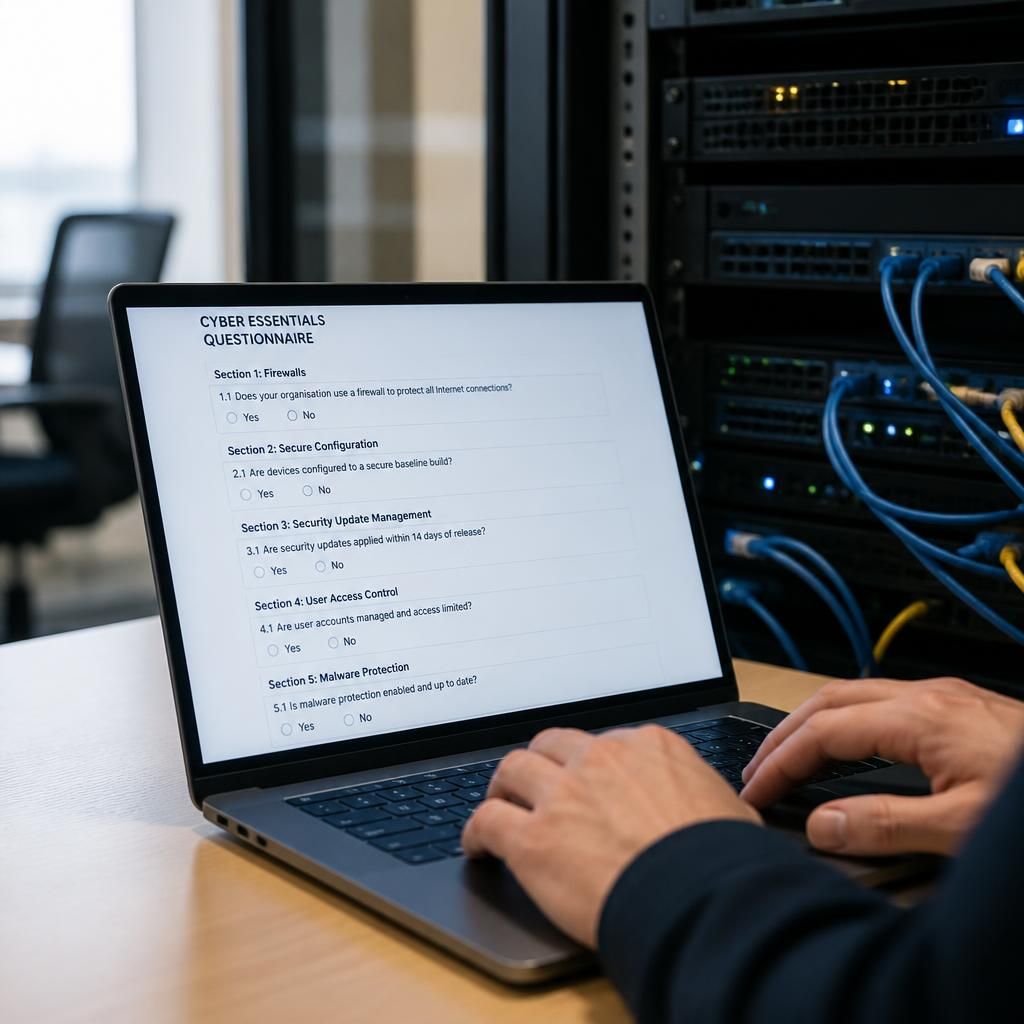
Cyber Essentials certification involves completing a verified assessment of a small business’s security against five core controls: firewalls, secure configuration, security update management, user access control and malware protection. The business completes a questionnaire about its systems and addresses any gaps before submitting it for assessment and certification.
Cyber Essentials certification is a formal assessment of whether a small business has applied the scheme’s required baseline security measures across its defined IT environment. The process normally involves setting the assessment scope, completing an organisation-specific questionnaire, resolving identified weaknesses and submitting the completed assessment to an approved certification body for review.
The first step is defining the scope. The business must identify which systems, devices, users, locations and cloud services are included. This may cover office computers, laptops used remotely, servers, network equipment, virtual infrastructure, internet-facing services and software-as-a-service platforms. The scope should reflect how the business actually operates rather than describing only the equipment in its main office.
Remote workers, home-based devices, mobile equipment and third-party hosted services need particular attention. If they connect to business systems or process business information, they may need to be included or otherwise accounted for in the assessment. A narrow scope that leaves out relevant technology can make the certification misleading and may prevent the business from meeting a customer or tender requirement.
The business then completes the assessment questionnaire. The questions require practical information about how the organisation manages its technology. For example, the business may need to explain how it controls administrative privileges, applies updates, configures devices, protects against malicious software and separates or filters network connections. Answers should describe the current environment and controls in place, not the intended future state.
Supporting records are not usually a substitute for accurate answers, but they help the business verify its position before submission. Useful preparation material may include an asset inventory, user and administrator lists, device-management records, update reports, firewall configuration information, access-control procedures and evidence that security software is active. The exact information required depends on the current assessment requirements and the certification body’s process.
Any gaps must be addressed before submission. Common preparation work includes removing unsupported software, applying overdue security updates, replacing default passwords, restricting administrator access, disabling unnecessary accounts, improving device configuration and confirming that protective controls cover all in-scope equipment. Changes should be tested so that they do not disrupt essential business applications or legitimate remote access.
A business should also check that its answers are consistent. For instance, an asset list should broadly match the devices managed by the organisation, and access-control answers should reflect what users can actually do. Inconsistencies can reveal unmanaged systems or exceptions that need to be resolved before the assessment is submitted.
The completed questionnaire is submitted through a certification body. Cyber Essentials is primarily a verified self-assessment: the organisation supplies its answers, and an assessor reviews them against the scheme requirements. This is different from a full penetration test or an unrestricted audit of every technical configuration. The basic certification therefore depends heavily on the accuracy and completeness of the information provided.
If an answer does not meet the scheme requirements, the certification body may identify the issue and explain what needs to be corrected. The business may then need to make further changes and amend or resubmit its assessment, subject to the rules and timescales of the chosen certification process. It is sensible to resolve uncertainties before submission rather than treating the questionnaire as a purely administrative form.
Cyber Essentials and Cyber Essentials Plus are different levels of assessment. Cyber Essentials uses the verified questionnaire route. Cyber Essentials Plus includes the questionnaire as well as additional technical verification, such as checks on sampled devices, user accounts and network security arrangements. Plus is more demanding and involves testing by an approved assessor, so it requires more preparation and may be relevant where customers, contracts or internal risk requirements demand stronger assurance.
A successful assessment results in a certificate for the organisation and the scope that was assessed. The certificate does not mean that every possible cyber attack has been prevented, nor does it certify the quality of all business processes. It demonstrates that the organisation met the scheme’s baseline requirements at the time of assessment. It does not replace risk assessment, staff awareness, backup planning, incident response or compliance work that may apply to the business’s sector and data.
Certification is time-limited. The business must review its environment before renewal and confirm that its systems, users, suppliers and working practices still fit the declared scope. A change such as adopting a new cloud platform, opening another site, replacing an endpoint-management system or introducing a new remote-access method can affect the assessment. Maintaining an accurate inventory and recording significant technology changes makes renewal more manageable.
The cost depends on factors such as the certification level, the organisation’s size category, the certification body and the complexity of the scope. There may also be internal costs for correcting weaknesses, documenting the environment or obtaining technical assistance. A business should confirm current fees and scheme conditions directly through its selected certification route rather than relying on an old quotation.
External IT support can help a small business prepare by reviewing the scope, checking its answers against the current requirements, identifying technical gaps and organising remediation work. The business remains responsible for confirming that the answers are accurate. Support with preparation should not be confused with issuing the certificate: certification is completed through an approved certification body.
For a small business, the most reliable approach is to treat Cyber Essentials as a review of everyday technology management rather than a one-off form. Keep an accurate asset and account inventory, remove unnecessary access, manage updates and configurations consistently, record exceptions and reassess the environment whenever the business changes its systems. This produces a more credible assessment and helps the controls remain relevant after certification.
Before starting, a small business should confirm what the requesting organisation actually requires. A customer, tender or insurance condition may ask for Cyber Essentials or Cyber Essentials Plus, and may specify which legal entity, sites or systems must be covered. These details affect the assessment scope and the level of assurance needed.
Check the wording of the requirement rather than assuming that any Cyber Essentials certificate will be accepted. Confirm whether the certificate must be current on a particular date, whether remote users and hosted services need to be included, and whether the organisation requires the additional technical verification provided by Cyber Essentials Plus. This avoids completing an assessment that does not meet the purpose for which certification was requested.
Need help preparing for Cyber Essentials certification?
If you are unsure whether your current systems and working practices meet the certification requirements, S2 Technology Group can help you identify the areas that need attention. Contact us to discuss preparing your small business for Cyber Essentials certification.