How should small businesses prioritise cyber security risks?
Small businesses should prioritise cyber security risks by assessing both the likelihood of an incident and the potential impact on critical data, systems and operations. Address risks first where they could cause significant disruption, expose sensitive information or prevent the organisation from serving customers, while also considering existing weaknesses and available controls.
Small businesses should prioritise cyber security risks through a documented, repeatable assessment of likelihood, business impact and the strength of existing controls. The highest priorities are usually risks that could stop essential services, compromise valuable information, enable access to other systems or affect legal and contractual obligations.
Start by identifying what the organisation must protect and what it depends on. This should include customer and employee information, financial records, email, line-of-business applications, file stores, websites, connectivity, endpoints and operational technology where relevant. Record who owns each asset, where it is hosted, who can access it and whether the business could continue without it. An asset that appears less sensitive may still be important if other processes depend on it.
Next, consider the ways each asset could be compromised. Common risk sources include stolen credentials, phishing, exposed remote access, unpatched software, misconfigured cloud services, lost devices, malicious insiders, supplier compromise and inadequate backups. The assessment should consider both external attack routes and internal weaknesses, rather than focusing only on the most visible threat.
Assess likelihood using evidence rather than instinct. Relevant factors include:
- whether the system or service is exposed to the internet;
- how attractive the data or access would be to an attacker;
- whether known vulnerabilities remain unpatched;
- the number and privilege level of users who can access the asset;
- whether phishing, malware or similar incidents have affected the organisation or its sector;
- how effectively preventive and detective controls are configured; and
- whether a supplier or connected system creates an additional route into the environment.
Impact should be assessed in business terms, not only in technical terms. Consider the consequences of losing confidentiality, integrity or availability, including interrupted operations, missed customer commitments, fraudulent payments, regulatory or contractual issues, loss of intellectual property and damage to trust. Also consider whether an incident affecting one system could prevent access to several other services.
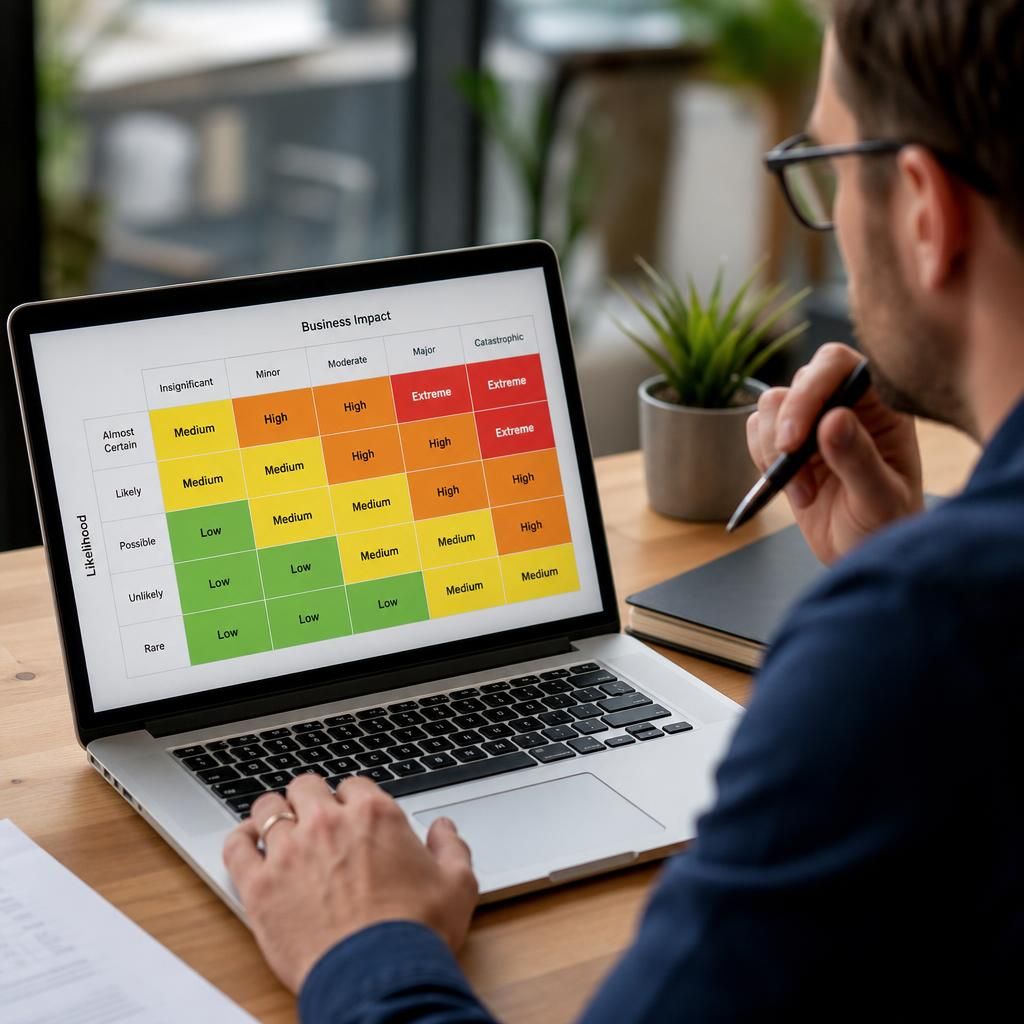
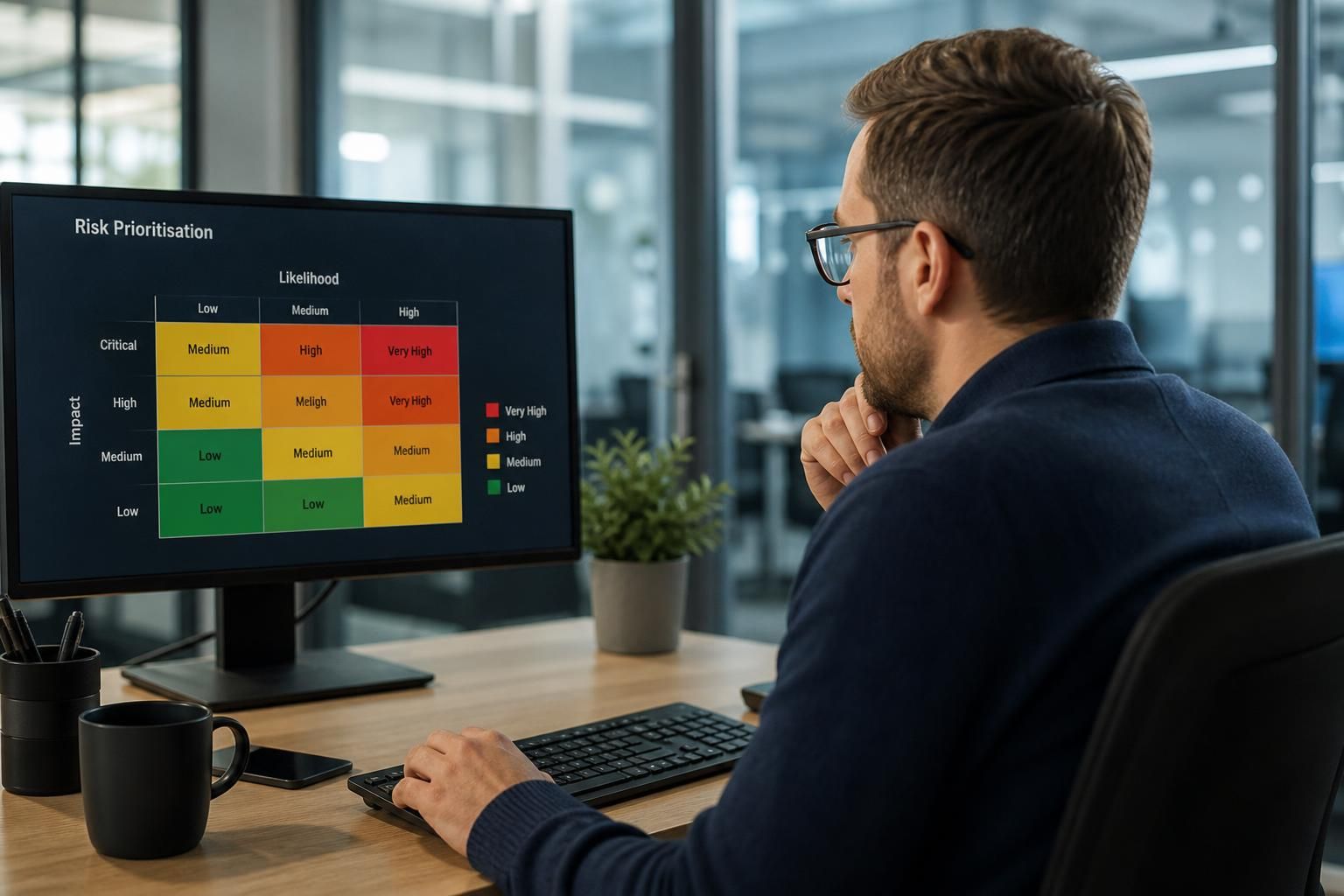
A simple risk register is often sufficient for a small organisation. Each entry can record the asset, threat, weakness, possible consequence, existing controls, risk owner, proposed treatment and review date. A qualitative scale such as low, medium and high can make decisions easier, provided the organisation defines what each level means. A numerical score can create false precision if the underlying assumptions are not explained, so the reasoning behind the rating matters more than the calculation.
When several risks have similar ratings, use practical tie-breakers. Give preference to actions that:
- protect a critical business process or privileged account;
- remove a widely used attack route, such as weak authentication or unsupported software;
- reduce the consequences of a likely incident, such as by improving recoverable backups;
- address several related risks at once;
- are required by a contract, regulation or insurance condition; or
- can be implemented safely without creating a new operational weakness.
Risk treatment should then be planned in a sensible order. Some risks can be avoided by removing an unnecessary service or access permission. Others can be reduced through measures such as multi-factor authentication, secure configuration, patch management, least-privilege access, network separation, tested backups, endpoint protection and staff training. Cyber insurance or contractual arrangements may transfer part of a financial consequence, but they do not replace technical controls or restore lost data. A risk may be accepted where treatment would be disproportionate, but acceptance should be explicit, approved by an appropriate decision-maker and reviewed rather than left undocumented.
Do not treat low-cost actions as automatically higher priority than larger technical projects. A quick configuration change may reduce immediate exposure, while an infrastructure upgrade may be necessary to remove a persistent weakness. Conversely, a complex project should not delay basic controls that protect administrator accounts, email, backups and internet-facing systems. A prioritised plan should separate immediate risk reduction from longer-term improvements and state the dependency, owner and target date for each action.
Controls should be prioritised according to how they work together. For example, strong authentication reduces the chance of account takeover, restricted privileges limit what a compromised account can do, monitoring can identify unusual activity and reliable backups can support recovery. Relying on one control creates a single point of failure, particularly where an attacker may be able to bypass it or where staff cannot use it correctly.
Review the priorities when there is a significant change, such as a new cloud service, acquisition, office move, remote-access arrangement, supplier connection or major change to staffing. A review is also appropriate after an incident, failed control test, serious vulnerability disclosure or change in contractual requirements. The purpose is not to produce a permanent ranking, but to keep decisions aligned with the organisation’s systems, obligations and tolerance for disruption.
For a small business without dedicated security expertise, an IT or cyber security assessment can help validate the asset inventory, identify technical exposure and turn the risk register into an achievable treatment plan. The business remains responsible for deciding which services and information are most critical, how much disruption it can tolerate and which risks it is prepared to accept.
Cyber security risk prioritisation is more useful when a business distinguishes between inherent risk and residual risk. Inherent risk is the exposure before controls are considered; residual risk is the exposure that remains after existing safeguards are taken into account.
This distinction prevents a well-controlled high-value system from being treated in the same way as an equally important system with weak protection. For each significant risk, record:
- the likely consequence if the threat succeeds;
- the controls currently relied upon;
- evidence that those controls are operating as intended; and
- the remaining exposure after those controls are considered.
Residual risk should be compared with the level of disruption and loss the business is prepared to tolerate. Where it exceeds that threshold, the treatment plan should identify the additional control needed and the person responsible for approving or monitoring the decision. This makes the risk matrix a record of informed decisions rather than a one-off ranking exercise.