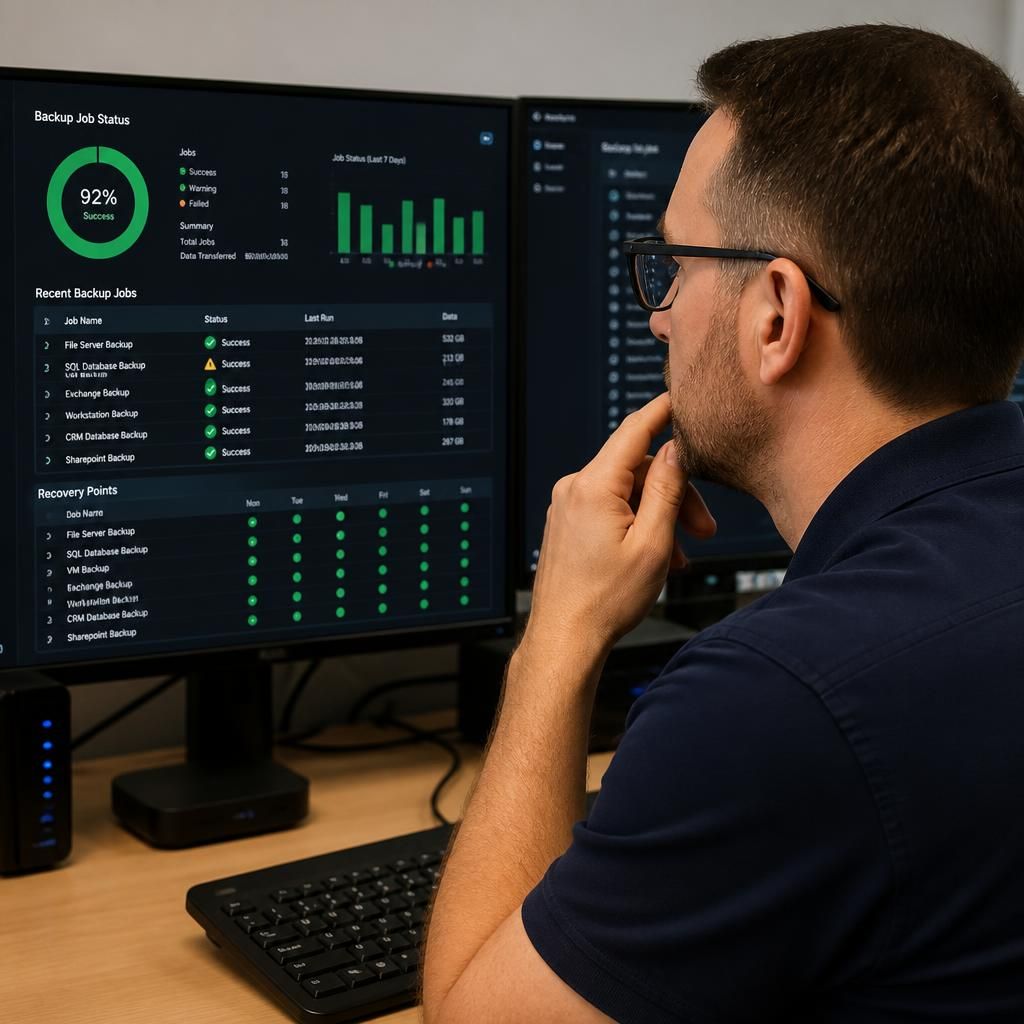
What does a managed backup service include?
A managed backup service typically includes automated data backups, secure storage, job monitoring, retention management and recovery support. It also provides ongoing oversight to help identify backup failures and confirm that business data can be restored when required.
A managed backup service is a complete process for designing, configuring and administering data protection, rather than simply supplying backup software. It usually combines an assessment of the organisation’s systems with appropriate protection methods, security controls, documented procedures and practical recovery options.
Initial assessment and backup design
The service begins by identifying the systems and data that require protection. This can include physical servers, virtual machines, workstations, cloud workloads, databases, shared files and business applications. The design should also consider dependencies between systems, such as an application relying on a particular database or file share.
Each workload can then be classified according to its business importance, data volume and recovery requirements. This helps determine which protection method is appropriate and prevents critical systems from being treated in the same way as replaceable or low-priority data. The design should record what is included, what is excluded and how exceptions are handled.
Workload-aware protection
Managed backup may include different methods for different types of data. File-level protection can be suitable for documents and shared folders, while system images can help preserve an entire server or workstation configuration. Application-aware protection is important for databases and transactional systems because a simple copy may not produce a usable application state.
Configuration can also cover the protection of system settings, user profiles, permissions and other information needed to rebuild an environment. Where a business uses cloud services or multiple sites, the backup design should make clear which data is protected by the service and which responsibility remains with the customer or platform provider.
Security and separation of backup data
A properly designed service includes controls intended to reduce the risk of backup data being altered or deleted. These may include separate administrative accounts, least-privilege access, multi-factor authentication, audit records and safeguards against unauthorised changes to backup configurations.
Organisations may also use isolated, immutable or offline copies so that a security incident affecting production systems does not automatically affect every available recovery copy. Encryption during transfer and while data is held can form part of the design, with access to encryption keys and administrative credentials managed separately from ordinary user accounts.
Documented recovery procedures
Managed backup should define how different recovery scenarios are handled. This may include restoring an individual file, recovering a folder, rebuilding a complete machine, restoring a database or bringing a wider service back in a controlled order. The procedure should identify who can authorise a restore, where recovered data is placed and how conflicts with existing data are managed.
Documentation is particularly important when recovery involves several interconnected systems. It can set out system dependencies, recovery priorities, required credentials and escalation routes, giving the organisation a repeatable process rather than relying on staff memory during an incident.
Administration and service governance
A managed service commonly includes configuration changes when systems are added, removed or substantially altered. It should also provide a clear record of policy settings, protected workloads, exclusions and recovery requirements. Regular review helps ensure that changes to the business do not leave a new server, application or data source outside the protection plan.
Reports and service records can give responsible managers evidence of the protection status of important systems and identify decisions that need attention. The exact scope varies between providers, so a prospective customer should check whether the service includes configuration changes, restore assistance, documentation, security controls and protection for cloud or remote users.
S2 Technology Group provides managed IT and cyber security services for organisations around Stourbridge, Kinver, Wordsley, Kingswinford, Kidderminster, Halesowen, Dudley and neighbouring areas. Its managed backup approach can be considered as part of a wider plan for secure, resilient and recoverable business systems.
A managed backup service should verify that backup data is usable, not merely confirm that a scheduled job has completed. Verification can include checking that files are readable, backup sets are complete and data can be interpreted by the relevant system. This helps distinguish a successful data transfer from a recovery point that is genuinely suitable for restoring business information.
The verification process should produce records showing which backups were checked, whether any inconsistencies were found and what corrective action is required. Where a backup is incomplete or cannot be validated, it should be reported as a protection issue rather than treated as a successful job. This gives the organisation a clearer view of recoverable data and supports informed decisions about backup configuration and storage.